Showing posts with label bugs. Show all posts

Saturday, June 27, 2020

Return of the "Flying Flowers"

The first butterflies usually appear in my little section of Northwest Wyoming in late April. It is always a surprise to discover the bright splashes of color during days which are still often more like winter than summer. Almost always, the early arrivals are the Wyoming state butterfly, Sheridan's Green Hairstreak. They tend to disappear as quickly as they arrive and they are followed by a slow trickle of other species: Boisduval's Blue, Melissa Blue, then a Black Swallowtail or two, maybe a Crescent and a Checkerspot, gradually building in number and species until we get to mid-June and it suddenly seems like there are "flying flowers" everywhere! And once the Fritillaries and the Wood Nymphs arrive, the air is full of color and motion! 

Below are just a few of the species I see on a regular basis this time of year. 

Fritillaries on Sand Verbena

Northern Checkerspot on Blanket Flower

Ruddy Copper on Catamint

Grey Hairstreak

Juniper Hairstreak

Wood Nymph

Tiger Swallowtail collecting moisture

Thursday, June 11, 2020

Learning to See

As you can probably guess, when we are talking about finding and photographing insects, "learning to see" is not about the results of your latest eye exam. Rather, it is about training yourself to be aware of even the smallest creatures that share our world. 
Like all living things, humans have evolved to survive a scary world. That means we are especially attuned to things that might threaten our health and safety. There is little chance we would not notice a grizzly bear in our yard but we can walk right by a multitude of insects day after day, year after year and not even realize they are there!
There are several steps we can take to awaken our senses in regards to the insects that surround us. 

1. Education
    It is probably pretty obvious but the number one things we can do to jump start our insect awareness is to educate ourselves on what should be found in our area. Field guides are invaluable in helping to identify various species as well as in providing range maps for them. Wildflower books for your location can help identify plants and once you know more about the flora, you can begin to explore the insects that use those plants for food or as habitat. 


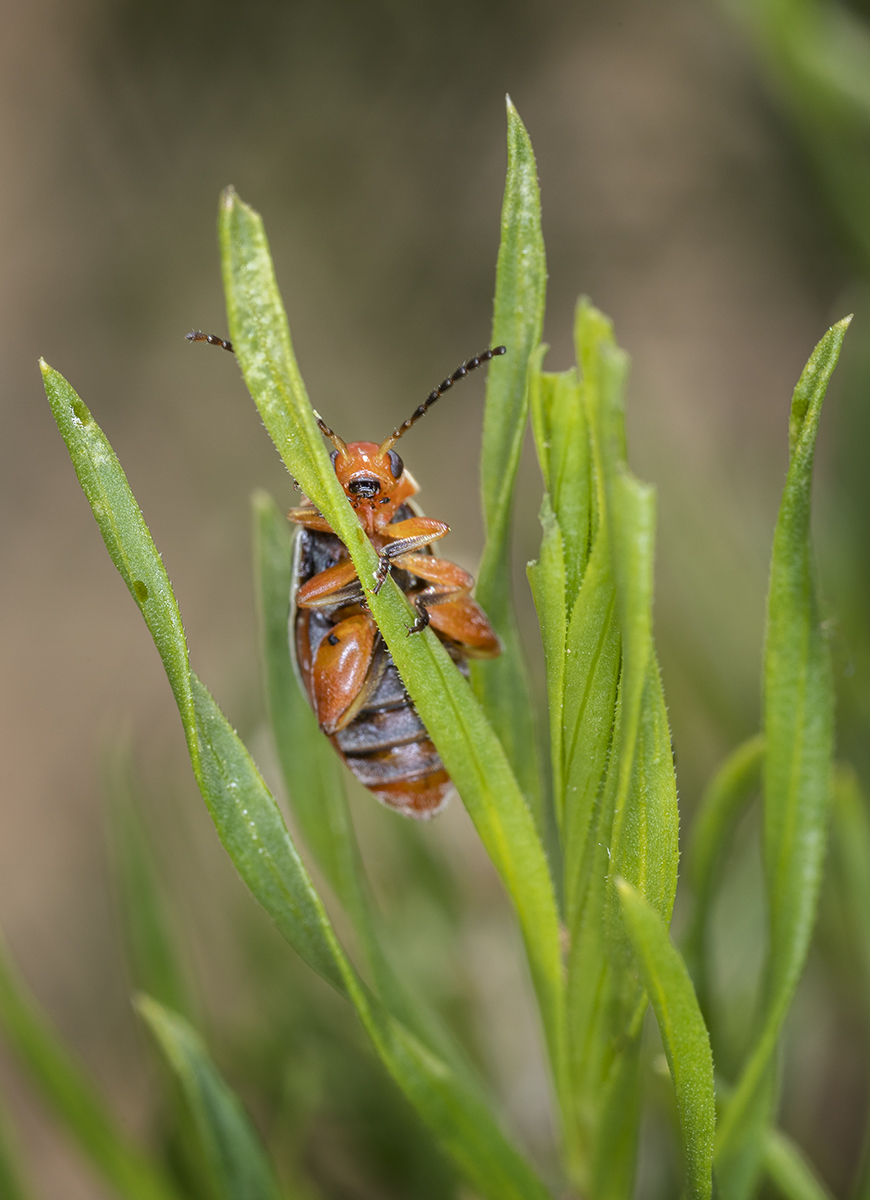
Sumac flea beetle

On my property there are dozens of skunk sumac bushes. Over the years I noticed that occasionally the leaves of various bushes would be riddled with holes. Upon closer examination, I discovered the larval form of an unknown insect munching away on the plants, usually in mid-summer. It wasn't until I started really staring at the plants this year before they leafed out that I discovered the adult insect, above. These are sumac flea beetles and it turns out they are quite common. There are probably many dozens spread throughout my property but it took me almost three decades to see my first one!

It is also helpful to educate yourself on the various forms an insect might take. The photos below both depict the white-lined sphinx moth but one shows the larval stage while the other shows the adult moth. 
Caterpillar of white-lined sphinx moth
Caterpillar of sphinx moth
White-lined sphinx moth


2. Pattern Recognition
    Camouflage clothing works because the fabric patterns blend into the background. Many insects are experts at doing the same thing. Some insects mimic very specific things in nature, such as leaves or twigs, while others use pattern as means of blending into their surroundings. 

Hooded owlet moth
This hooded owlet moth hangs out on tree trunks or wooden structures. Unless you are looking very closely at the surface, it is easy to look right at this moth and not see it. Even the circles on the wings are meant to mimic knotholes in the wood. 
It is possible, with practice, to train your eyes to pick up on the subtle difference in pattern of various insects and their backgrounds.

3. Visualization
    Athletes and business people have been successfully using the technique of visualization as a means of achieving success for years. But visualization can help with many things, even finding insects! Once you know what creatures are likely to be found in your area, you can start trying to visualize them on various surfaces when you are out and about. Just like becoming aware of a particular word for the first time and then seeming to hear it regularly from then on, once you visualize a particular insect and then find it, it often seems that you start seeing that species on a regular basis.

Brachys aerosus
The tiny metallic wood-boring beetle, Brachys aerosus, is very difficult to spot unless you can picture what it is you are looking for. Not only are they about the size of the head of a pin, they often tuck in their legs and antennae so it is hard to even realize you are viewing a living creature. But once you visualize their form, you may suddenly realize there are dozens of them to be found on a single cottonwood tree. 

4. Time in the field
    After education, spending time in the field practicing looking for insects is probably the best technique to ensure future success. The more time you spend outside, the more you will see and I am willing to bet you will be astonished to discover the richness and diversity of the landscape right outside your home! 


Saturday, May 30, 2020

Bug on a Stem

A few years ago I had a lecture that I gave several times to various groups titled "Bird on a Stick". In it I discussed three stages of bird photography as I saw them.

The first stage was "UFO" or Unidentified Flying Object. At that level, the photographer knew she had witnessed a majestic bald eagle soaring overhead but she was having a hard time convincing anyone else based on her grainy, out of focus image of a black dot against a white sky.

Her frustration might lead her to take some classes, maybe upgrade her equipment and, most importantly, practice, practice, practice. That would lead to the second stage which I called "Bird on a Stick". In that stage, the photographer was making lovely, technically correct images of identifiable birds. She was now the star of her Facebook birding group and all her non-photographer friends were telling her how great her images were. But in her heart, she knew something was still missing.

So then she started studying the photographers whose images spoke to her. She began exploring the stories behind the images and learning more and more about her subjects. At that point she discovered the third stage which I like to think of as the "Tell Me More!" stage. At that level the photographer has ceased being a mere image recorder and has begun to truly communicate something about her subject to the audience. She has sparked a reaction in the viewer that makes them want to know more about the intriguing creature they see in front of them.

I believe those stages also exist in bug photography.

In the beginning, you may be trying to capture that beautiful butterfly in your garden. But bugs have very good eyes and you may quickly discover they really don't like having cameras shoved in their faces. And bugs are fast! Just as you get set up, ready to click the shutter, off they go, never to be seen again. Photographing butterflies and bees can quickly morph into trying to capture images of all sorts of bugs, many of which are probably unidentifiable unless you study entomology in your spare time.


My first shot of a flea beetle in my yard.

So you study up, do your research, watch some podcasts and Youtube videos. That leads to buying a decent macro lens and maybe even some lighting equipment. Now you can capture those great i.d. shots, the "Bug on a Stem" images that allow you to search in your new bug book to discover that the tiny creature you are looking at is a flea beetle, Disonycha latifrons, to be exact.
A beautiful flea beetle seen from above.

But something is still missing.
Flea beetle peeking around the corner of a leaf, watching the watcher. 

So now it is time to strive for those "Tell Me More!"shots. With bugs, these types of shots seem even more critical because it is not easy to get people to stop and look in wonder at the beauty before them.  The variety in insect appearances and behaviors is mind boggling and absolutely intriguing, if only we can spark that curiosity in people to look more closely and to ask for more of the story.

That is my goal. To make people look. To introduce the individual in all his wonder and glory. To be the storyteller.

Wednesday, May 27, 2020

Let's go "bugging"!

I believe the major reason people tend to be largely ignorant about the number and diversity of bugs in their midst is that they simply don't see them. Let's face it - bugs are small. If you would ask the average person to describe the bugs in their backyard on any given day in the summer, they would probably come back with a list of mosquitoes, flies, bees, butterflies...maybe a moth or a wasp. My guess is that there are dozens of bugs present but people just aren't aware they are there.

Golden-haired flower beetle
I think we should start a new pastime - Bugging! Lots of people go out into nature to look for birds. They are "birders" going "birding". Their goal may be to photograph the beautiful flying creatures or to check off a new species on a list they faithfully keep or simply to enjoy the color and complexity of each unique bird. Why can't we do the same thing with bugs?

Agapostemon Bee
One of my favorite activities for kids (or adults) is "bug bingo". Each participant gets a card with a mixture of names of common bugs: bee, butterfly, caterpillar, ant, etc. As you hike along a trail or explore an area, each participant tries to fill their card first by spotting the listed insect before anyone else. It is a fun event that is also educational. I think we should expand the idea and create checklists of bugs that can be found in a particular area and encourage anyone exploring to try to fill in their checklist with their sightings for the day.

Maybe if people were more used to looking for bugs in their midst, they would start to become aware of just how many there are and how beautiful each one is!


Metallic wood boring beetle

Monday, May 25, 2020

Change

It is hard to believe that it has been more than 2500 years since the Greek philosopher, Heraclitus, declared that "The only constant in life is change". Somehow the message seems just as valid today as it no doubt was during those ancient days.

A couple months ago I listened to a discussion on NPR in which the scientist being interviewed had conducted a study regarding the concept of personal change in individual lives. The simplified summary is that he asked a group of people at various stages in their lives two questions: 1) How much has your life changed in the last five years? and 2) How much do you expect your life to change in the next five years? Invariably the answers to the questions were 1) a lot and 2) not much. Somewhat unsurprisingly, the belief that everything would remain static into the future was more pronounced the older the subject being asked the question. Then he went back five years later and asked the same question of the same people, and again another five years after that and each time, the answers were exactly the same! That is "My life has changed a lot in the last five years but it is not going to change in the future." But of course, it did!

If someone had suggested to me twenty years ago that I would be spending the bulk of my days searching for, taking and editing photographs at this point in my life, I would have had a hard time believing it. If someone had told me three years ago that almost all the photos I would be taking would be of bugs, I would have said they were crazy! Yet that is where I find myself at this stage of my life - and loving it, I should add.
Close-up image of a dragonfly

Cabbage white butterfly

Bee fly
The great unknown for me as I go forward is whether or not I can find a way to use my images of tiny things to communicate an environmental message. Not only is there the bigger story of the importance of biodiversity in our world, there are the individual dramas of each unique creature with its unique purpose for existence. 

I look forward to telling their stories in much more detail!