Showing posts with label Wyoming. Show all posts

Saturday, June 27, 2020

Return of the "Flying Flowers"

The first butterflies usually appear in my little section of Northwest Wyoming in late April. It is always a surprise to discover the bright splashes of color during days which are still often more like winter than summer. Almost always, the early arrivals are the Wyoming state butterfly, Sheridan's Green Hairstreak. They tend to disappear as quickly as they arrive and they are followed by a slow trickle of other species: Boisduval's Blue, Melissa Blue, then a Black Swallowtail or two, maybe a Crescent and a Checkerspot, gradually building in number and species until we get to mid-June and it suddenly seems like there are "flying flowers" everywhere! And once the Fritillaries and the Wood Nymphs arrive, the air is full of color and motion! 

Below are just a few of the species I see on a regular basis this time of year. 

Fritillaries on Sand Verbena

Northern Checkerspot on Blanket Flower

Ruddy Copper on Catamint

Grey Hairstreak

Juniper Hairstreak

Wood Nymph

Tiger Swallowtail collecting moisture

Wednesday, July 4, 2018

Wild and Scenic

In celebration of the fact that the Wild and Scenic Rivers Act turns 50 this year, Ken and I have been wanting to get back to one of our favorite spots on the Clarks Fork to get some shots of the canyon. After all, it isn't everyone who can brag they have Wyoming's first Wild and Scenic River practically in their backyard! Today seemed like a great day for a hike, even though the sky was actually too blue  to get the landscape shots I was hoping for, so we left home about 6:30 am and headed to the parking lot at the canyon mouth. 
"Wild and Scenic" signage at the canyon mouth.
 Like most of our hikes we needed to travel off-piste to get to the location we had in mind. We had about a two mile hike in followed by a relatively steep climb of 1000' up a rocky slope to reach a narrow pass where we had a small flat area to set up and wait for the light to be where we wanted it. The north side of the pass is an even steeper drop straight down to the canyon floor.

Like always, I traveled with my telephoto lens on my camera but once we got to our destination I switched it for my much shorter landscape lens. I then went to work setting up my tripod and locking down the camera in preparation. Ken was doing the same, setting up a little higher than me, on my right. I should note that Ken's hearing is pretty bad these days which can make for some interesting moments.

I was looking through my viewfinder, fiddling with the settings and trying to make sure everything was level when I heard a loud rustling on my left. In the same instant I wondered how Ken had managed to get by me I realized that wasn't possible and I looked up and directly into the face of a large black bear standing about 10' away. I am not sure whose eyes got bigger - mine or the bears! I turned to Ken and shouted "Bear!"and by the time he looked up and I turned back all we saw was the black furry butt moving away from us at top speed across the face of the slope we had just climbed.
No hike in the canyon is complete without a side trip to Bridal Veil Falls.
 Neither one of us managed to get a shot off but it was quite a thrill just to see the bruin in that location. It would have been one of the last places I would expect an encounter but it was a good reminder that we are indeed in a "Wild and Scenic" spot!
5-shot panoramic of the canyon looking southwest. 

The Clarks Fork River from a lower viewpoint.

Checkerspot Butterfly. 

Monday, June 18, 2018

Cacti

 Despite the fact that we live in high desert - or maybe because of it - the wildflowers of spring are always a treat. This has been an exceptional year so far because of an unusual amount of moisture that is still falling today.

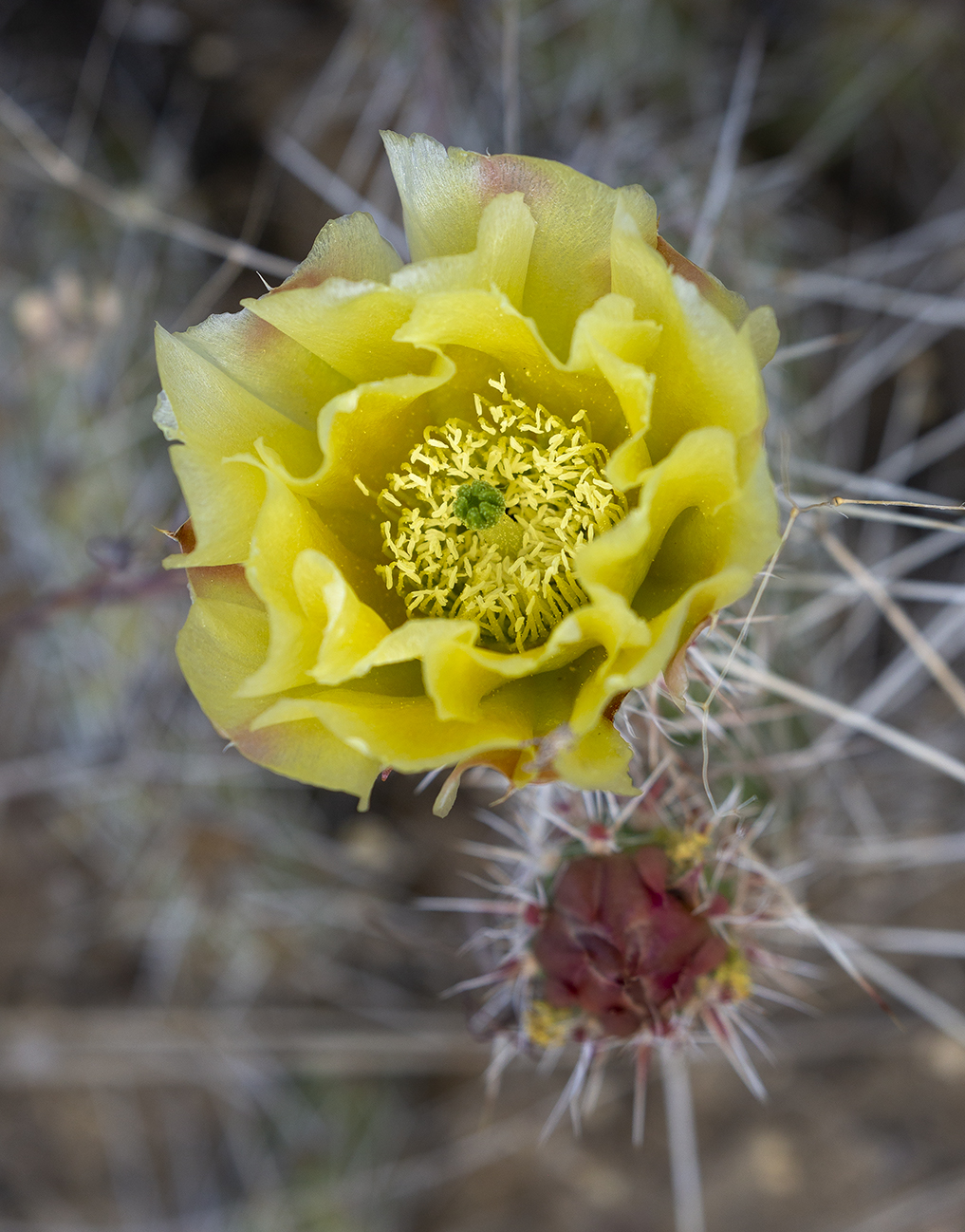
One of the classic desert plants is cactus. We have two varieties on our place: Prickly Pear, which makes up about 99.99% of the spiny species and Cushion Nipple Cactus, which makes up the other .01%.

The Prickly Pear are just starting to bloom and like everything else this year, they are amazing.

The flowers are usually yellow although we have a certain number that are salmon colored or somewhere in between.

 The blooms on the Cushion Nipple Cacti are much smaller and they seem to last for only a day or two (no wonder there are so few of them!) so it is tricky to catch them at just the right time. The amazing thing about their flowers is the coloration which makes them appear to glow from within.

Wednesday, June 6, 2018

Tolerance and Compassion

Rattlesnake coiled on the trail, level to the ground
I dragged my husband out of bed at 5 am this morning so we could hike to a location from which I wished to photograph the Clark's Fork Canyon at sunrise. The place I was envisioning setting up was a short drive away, followed by a hike of about a mile and half and an elevation gain of just under 1000'. We had been to this spot before and I knew it would be spectacular in the early morning light. 
There is no official route to the top but there are a few faint animal trails here and there. I was leading the way, following one of the paths between some small rocks when I heard Ken swear behind me. I went back to his location but it wasn't until he pointed to the ground that I saw this all-but-invisible rattlesnake coiled up right in the middle of the trail. Ken had been about to step on top of him. I obviously walked right over him and didn't even know he was there! Which brings me to the point of this post. 

I am sure that if I am ever bitten by a rattler, many of the comments will suggest I had it coming. I realize that is partly my fault - I talk about the venomous reptiles on a regular basis and no doubt my musings come across as cavalier at times. But I assure you that I have a healthy respect for these animals and the damage they can do. I protect myself by knowing their habits and by trying to be vigilant when I am in their territory. But stuff happens. And I refuse to sit in my house, avoiding the outdoors, just because I live in the land of bears, cougars and rattlesnakes! 

Panoramic view of Clark's Fork Canyon in the early morning
 There have been two instances of people being attacked by an elk in the Mammoth area over the last couple days. The first victim was a woman who works at the hotel and lives on the grounds. She was severely injured and had to be life-flighted to Idaho. The reports state that the cow elk was protecting her newborn calf which she had hidden nearby. The woman almost certainly did not realize the young elk was there nor that she was placing herself between mama and baby. Yet the comments on the post released by the National Park Service are almost entirely accusatory, suggesting the woman was "stupid" and "an idiot" for putting herself in that position. I am appalled by the lack of compassion and understanding for this tragic event. Yes, there are visitors to the park who choose to put themselves in harm's way by taking selfies next to a bison or trespassing on the fragile ground but there are also times when the unexpected happens and all our careful habits can't protect us from the surprise encounter. All we can do is our best.
Cultural site - probably Native American - on a hillside near the canyon

Thursday, August 10, 2017

Harvest Time

A sure sign of the beginning of the end of summer is the arrival of flocks of Pinyon Jays and Clarks Nutcrackers. Our yard goes from being relatively silent one day to a cacophony of screeches the next as word gets out that the Limber Pine nuts are ready for harvest. 
 The two species have differing goals for their plunder. The Pinyon Jays seem to grab a nut and then immediately find a hard surface upon which to crack it and eat it. The Nutcrackers, on the other hand, gather numerous nuts in each sitting, stuffing them into their cheeks until they can't fit any more. They then fly off and try to stash the nuts for later consumption. In the meantime the Rock Doves hover at the base of the trees hoping to grab any nuts that fall from the beaks of the birds above.
 This is the only time of year I seem to see Clarks Nutcrackers flying in loose flocks. The noise made by dozens of them flying overhead has to be heard to be believed. Their strong wingbeats flapping in unison sound like the approach of a fighter jet!

 I was reminded that these birds are not the only consumers of pine nuts when I found a large, fresh bear scat on the trail this morning during my morning run. By the look of the nuts and berries in the scat, the bears are finding plenty to eat right now!

Sunday, June 11, 2017

Home on the Range

Every year about his time the Violet-green Swallows move into our yard. They are such beautiful little birds and they seem to be very comfortable with people, often swooping to within a foot or two if I am outside in the morning. They usually hang around for at least a month but I think we may see them for a little longer this year.
 Our first project after buying our land almost 25 years ago was to build the bunkhouse. Shortly after we finished construction I bought a half dozen inexpensive bird houses and spent hours painting each one in a unique and colorful way. We stuck them up under the bunkhouse veranda, partly as decoration but also with the hopes that bluebirds might find and make use of them each spring. In the two decades plus since I don't think I have ever seen a bluebird took twice at these little cottages although they occupy a number of other houses in the vicinity.
I'm surprised these little houses have kept any color after two decades in the sun.
 Then this year, for whatever reason, the Violet-green swallows decided they would take up residence. What a treat it has been to watch them bringing in hay each morning and guarding the houses against the bluebirds which now seem to have decided that even though they don't want the homes, no one else should be allowed to live there!
This pose shows the reason for the name. The violet is not always visible.

Bringing in a piece of straw bigger than she is!


Sunday, May 28, 2017

Kelseya

Kelseya looks like a cross between moss and bonsai. A closer look reveals tiny leaf clusters from whose centers the flowers bloom.
I like to think of myself as a flexible person, open to spontaneous adventure. But Facebook Memories reminds me that in regard to certain things, I am pretty much a creature of habit. For at least four of the last five years, Ken and I have made the hike to the top of Flatiron in the last week of May to search for blooming Kelseya. We knew that we were probably going to be too early this year because of the long winter and cool spring, and we were right. The flowers are just beginning to form and will probably be at their peak in another 10 days to two weeks. Unfortunately our calendar is pretty jammed for the next few weeks so we decided to make the trek anyway. 

Because of the location of this particular patch of flowers, it is not easy to simply say we will be back another day. Thanks to the generosity of our neighbor in allowing us to park in his back field, we were able to do the trip in about 5 hours. Although there is no public access, we can actually hike directly from our place but it adds another difficult five miles onto an already tough eight mile hike. After parking the car, the first mile is a fairly flat walk across the prairie but then you bushwhack, occasionally catching a game trail, to the top, climbing approximately 2500' over the next three miles. 

This plant is just beginning to form its beautiful red flowers.When in full bloom each flower will measure approx. 1/4" in diameter.
 It is hard to describe to anyone the sense of awe that comes when you reach the top of the dolomite uplift and discover about an acre of land blanketed with Kelseya. There are certainly areas where you can see this amazing and unique member of the rose family without expending quite this much energy but I have never seen such a vast and healthy Kelseya garden anywhere else. The plant is endemic to the Central Rocky Mountains and grows at about 7500' on limestone. It is the only species in the genus Kelseya in the rose family.
 Looking southeast from the top gives a view of Heart Mountain and the Clarks Fork River. The coolness of the day made for comfortable hiking and less haze in the distance.
Another surprise discovery was this patch of Alpine Clematis growing from a crack in a limestone wall.


I was photographing this Northern Flicker in a tree when Ken came over the ridge and spooked him. The sun caught his wings as he flew.
On our way to the back field we saw a pair of Magpies dive-bombing something in a pile of rock. When I got out of the car to see what they were harassing I discovered this Long-tailed Weasel staring back at me. 

 At certain elevations the Shooting Stars are in their prime.
The final image is a seven shot pano looking to the northwest from the top, along the Beartooth Front.  It is easy to see why this is such a wildlife corridor in the winter months as the animals retreat to lower elevations from the snowy peaks. The Forest Service is considering allowing a four-wheeler trail all along this stretch, a move I believe would be disastrous for wintering wildlife.

Sunday, May 7, 2017

Kits will be Kits

I am so grateful for friends who not only appreciate and respect wildlife but call me when they see something special! I received an email from a longtime friend informing me that they had a fox den under their barn and asking if I wanted to photograph the kits. It took about half a second for me to respond with an excited "YES!"
 Once I arrived the next evening I was shown the area of the den and told that they thought there were  five kits. Then I was left alone to see what I could capture. I had my small blind with me and I set it up outside the fence so I was peeking through. It was incredibly uncomfortable and after two hours of trying to stay relatively motionless I finally had the opportunity to photograph one brave kit who ventured out of the den. The good news was that it was pretty clear the young fox had no idea I was there. Between the direction of the wind and the blind, I seemed to be invisible although he did perk up his ears each time I clicked the shutter.

I decided to call it a night and return with a better plan a couple days later.
 When I came back the second time I took a few more minutes getting set up in a better location where I could be more comfortable. Almost immediately after pulling the blind over me I heard a loud noise and turned to see two cows and a horse watching with obvious consternation trying to figure out what this strange creature was that had invaded their space. It turned out to be the best thing to happen because the kits, when they popped out, were apparently fascinated by the bigger animals and kept trying to see what they were up to while once again completely ignoring me in my blind.
 This time around the kits all emerged at once and spent about an hour frolicking as I snapped gleefully away. And, surprise! Instead of five there were actually seven youngsters in the group. I don't know how mama fox feeds them all!
My favorite shots of the day were when the animals were interacting with each other. They would play for a while and then a mock fight would break out and they would growl and bark at each other sounding much bigger than they actually are.

Even though I often try to capture photos of animals without man-made structures in the images, I think the fact that they chose the environs of the barn as their den is part of this story. And the surroundings provide an obstacle course any youngster would be thrilled to explore!

Monday, March 27, 2017

Collaring Mule Deer

 A little over a week ago Ken and I had the opportunity to attend a mule deer collaring operation that was a joint effort between WGF, UW and TNC. I was given permission to photograph the event and ended up with a large number of images from the day. I should have put them in chronological order but I always seem to forget before I upload them and it is difficult to rearrange them once they are in the post!

The goal of the project is to track migration and habits of a large number of female mule deer along the Absaroka and Beartooth Mountain Fronts for the next two years to establish patterns. At the end of 24 months the collars will automatically fall off. They also have a break-away in case they would get snagged on something in the meantime. The collars will transmit coordinates several times a day so the animals can be tracked in real time.

While the researchers had the animals captive and lightly sedated, they also collected other data such as blood samples, pregnancy status, samples of scat, temperature and weight. Before release, the deer were spray painted with a bright orange spot on their head so they wouldn't accidentally be netted a second time by the capture crew.
 In the image above, the animals are gently lowered to the ground by the helicopter crew. Although I didn't get to witness the actual moment of capture of any of the animals, it was really amazing to watch the professionalism of those in the chopper as they went about the delicate maneuverings.
 In most cases the animals were brought in two by two but every now and then they arrived with a single deer. Even though the animals had their eyes covered, you know they had to be thinking WTH!

The moment of release seemed to be the time of biggest danger for the researchers. As soon as the animals were out of the restraints they were up and out of there, often with legs flying.