Showing posts with label travel. Show all posts

Monday, January 8, 2018

Circle B Bar Reserve

I have an ever-growing list of places I like to visit in Florida for birding and photography. At the top of the list for the last few years has been the Circle B Bar Reserve near Lakeland. I was all set to go last year but came down with the flu the day before we headed south and so ended up with an unproductive visit as far as photography or much of anything else. 

This year I was not going to miss another chance and so we headed inland on the day before Christmas with my mom and dad in tow. We had not been able to find out much on-line or by calling so were disappointed when we arrived to find the nature center closed for the holiday and a large portion of the paths closed to hiking. 

Even so, I have to say the experience was memorable and it is definitely a place I will continue to visit every chance I get. The sheer amount of birdlife was amazing. And what was there seemed to have very little concern for the excited public walking the well-marked trails through their habitat. 
 Some of my favorites were the Limpkins. Their strident voices could be heard from the time we arrived and there seemed to be brown and white birds everywhere we looked. At one point I heard an especially loud voice and when I tracked it down I discovered an adult Limpkin apparently warning her youngster who seemed to be wandering too close to a large alligator.
 I think these birds are beautiful and the shape of their bills is a study in evolution as they seem perfectly designed to get into the apple snails that make up most of their diet.
 Although birds are the most abundant inhabitants of the reserve, they are certainly not the only ones. This turtle seemed to pick a questionable location in the middle of one of the lesser used trails to lay its eggs.
 We spotted Sandhill Cranes in a number of locations. Although I have seen many of the big birds in the past, it was fascinating to watch them apparently hunting in water that reached up to their bellies.
 One of the more unusual birds that makes the marshland of the reserve its home is the Black-bellied Whistling Duck. They are easily identified by their beautiful colors, including the reddish bills.

This Snowy Egret, below, was nice enough to walk through a patch of wildflowers that mimicked the color of its lores.
Other birds we saw were Roseate Spoonbills, Wood Storks, Glossy Ibis, Coopers Hawk, Red Shouldered Hawk, Tricolored Herons, Little Blue Herons, Great Blue Herons, Bald Eagles and even a few Pied-billed Grebes. I am sure I am missing some but one of my goals for this year is to finally start recording my sightings so hopefully next time I visit this amazing place, I will be able to relate all the things I see!

Sunday, September 3, 2017

Catching up - PEI Birds

 The focus of my visits to Prince Edward Island is family, not photographs, but I always manage to grab a few shots of bird life on the island, even though I usually travel there with minimal equipment.

The trip this year was especially fun as we were celebrating my parent's 61st wedding anniversary and the whole family was there to participate.

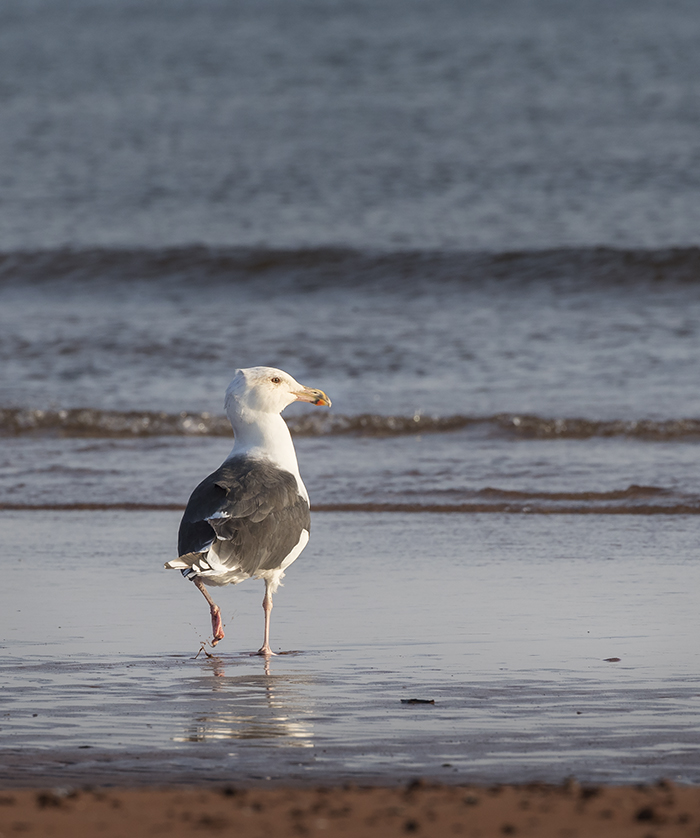
I love photographing the Great Black-backed Gulls at the beach. They are huge and are relatively tolerant of people. The red spots on their bills add a bit of color but the markings were especially noticeable on this big bird - maybe a sign of age?
 The red cliffs of Rustico Beach are visible in the background.
 The Finches on the Island were exhibiting signs of disease this summer so people were asked to take down all their feeders to prevent large numbers of birds from gathering in one spot. Of course that didn't stop the Goldfinches from finding natural feeding areas such as Sunflowers and Thistles.

The Kingfishers were out in force along the river in New Glasgow and that was where I really missed having a longer lens with me.

 There were lots and lots of shorebirds at Cavendish Beach, including this Greater Yellowlegs that I snapped off the Homestead Trail.
One of my favorite bird shots of the trip was this one of a pair of Ruddy Turnstones with a Bonaparte Gull for size comparison on the wharf in Summerside. The Turnstones are not residents of the Island - they stop by on their way through during migration. I was actually taking part in a water obstacle course in the harbor (another story!) when I spotted these guys near by.

Wednesday, July 12, 2017

Arctic Birds - Part 2

This second group of Arctic birds are those I consider more exotic for one reason or another. 

We expected to see Common Eiders on our trip and we weren't disappointed. I think they are beautiful birds even though they are often overlooked in favor of their more colorful and more rare relatives, the King Eiders. Several people warned us we were unlikely to see the latter as they are uncommon but in fact we saw quite a few more King Eiders than Commons! 
 We had the opportunity to photograph Common Eiders close up near the town of Longyearben but I prefer this image of a male and female pair flying in front of a glacier.
 Although we saw far more King Eiders than we expected, the sightings were always at some distance. Still, it is easy to see why they are so sought after as the colors of the males are quite spectacular.
 One of the birds I was really hoping to see was the Pink-Footed Goose. I finally had my chance to photograph a small group as they flew in front of a Kittiwake nesting wall. You will probably have to click on the image to really see the geese as they blend in so well with the background.
 We saw a few individual Puffins in the water but no groups. I believe we were too early for the nesting time.
 Another bird we saw quite regularly was the Purple Sandpiper. I really don't know how they got their name as they did not appear to be purple!
 My favorite bird images from the trip are those of the Red Phalaropes. This is the only bird species I have ever seen where the female is more colorful than the male. There is a good reason for the difference in coloring - in this family the female lays the eggs but the male then takes over and does all the work of raising the chicks, including sitting on the nest. He is more dully colored so he will be less visible. Red Phalaropes live almost their entire lives at sea. They are partners with the Blue Whales that they follow around for the majority of the year, finding food where the big mammals feed. They are only on land long enough to mate and raise their young and then back to sea they go.
 This pair of Red-throated Loons is a little distant to really appreciate their beautiful markings but they were a treat to watch.
Last but not least is another predator of the bird world, the Arctic Skua. We saw three of the four types of Skuas on our trip but none as close as this one who was protecting her "scrape" (nest) on the ground amidst the Purple Saxifrage.

Monday, July 10, 2017

Arctic Birds - Part 1

No matter where I am in the world, birds are always a focus for my photography. Although the variety of birds in the Arctic was less than in many places I have been, the sheer number of individuals was staggering. Most Arctic birds have a short time when they can come on shore to nest so they make the most of it.
 This post shows some of the more common birds we saw, such as the Arctic Tern, above. These birds are so delicate looking but they are ferocious in defense of their nests.
 Barnacle Geese are similar in size and coloration to Canada Gees.
This wall of Kittiwakes and Guillemots is indicative of what we saw in a number of locations. In the closer shot, below, you can get a sense for just how dense the population was. There were thousands of birds on each wall we visited.

 The Guillemots were also visible hanging out on ice floes far out from shore.

 We saw several different types of guillemots including this Black, left. It was fascinating to watch this guy use his red feet as rudders.
 One type of birds we saw constantly was the Fulmar. These guys are really, really cool, in my opinion. They are tube-nosed, which means they have a tube on top of their beaks which allows them to smell food from a long way off. They have a salt gland which excretes excess salt since they are constantly ingesting it as they skim along the top of the ocean. So their nose is always running with salt snot. And their greatest defense against predators is to throw up on them. Their puke is so toxic it will mat the plumage of predators, causing them to be unable to fly and so to die. Wow!
 Speaking of predators, the most common one of other birds on Svalbard is the Glaucous Gull. These guys are huge and ferocious. They steal eggs and attack smaller birds and chicks.
 In the photo above, the female Glaucous Gull is sitting the nest while the male watches over her. It looked to me like she was riding side-car.
The only song bird of the Arctic is the Snow Bunting. It was such a treat to see and hear them since they occasionally show up in Wyoming in mid-winter. Their version of going south in the colder months!

Thursday, July 6, 2017

Ice Bears - Part 2

I not only have a lot of photos of polar bears from our trip, I have photos of a lot of different bears. Each seemed to have their own personality and degree of comfort with the large ship passing by. 
 Some stayed where they were watching us with a mild curiosity while others came closer and still others left as fast as they could.


 The bear, above, is one of my favorites for a very selfish reason. I was all alone on the bow at about 5:30 am when a crew member came down from the bridge to tell me they had spotted a bear on an ice floe we were approaching. The official wake-up call was sounded each morning at 6:45 am and the policy seemed to be that there would be no announcements made before that time. The plan was to get in position and just wait with the bear in sight until people awoke. As we got closer I managed to get the one shot, above, of the bear resting before he became aware of us and entered the water, quick as a flash. That was the last we saw of him. So this is the only photo of that particular bear. I love how his head is down and his butt is in the air.

We had many opportunities to see bears rolling and sliding in the snow. The female, below, was particularly active and I captured lots of images of her in comical poses.

She was also the only bear we saw with a collar on which made for less than ideal photos. Only female bears can be collared for a very simple reason: on males, their neck is larger than their head. Collars would slide right off!


My iMac died this morning. The only good news is that it has been giving me warning signs for the last few weeks so I had everything backed up but I am left without the ability to edit images until I replace it. It was 7 years old so I can't imagine it is worth trying to fix, even if it was possible (which it really isn't in remote Wyoming). I have edited almost all my Arctic images so I can continue to post those photos for a while but things are certainly a little more difficult for the time being!

Wednesday, July 5, 2017

Pinnipeds and Cetaceans

One of the things I really appreciated about traveling with Lindblad/National Geographic was the opportunity to learn about the environment and wildlife we encountered along the way. Each day we had the option of attending a lecture by one of the numerous experts on board, some of which have changed the way wildlife is managed based on their research and studies. I am not sure I could have told you what a Pinniped (including seals and walrus) or a Cetacean (whales, dolphins and porpoises) was before this trip. 
 We saw both ring seals and bearded seals on our journey although I only managed to photograph the latter. In the first photo I am featuring a young seal that came up to the ship early one morning to inspect and then continued on his way. In the photo, below, this older bearded seal seemed unconcerned with our presence as we drifted by. Seals are the main source of food for polar bears so they are usually wary of anything getting too close.

 We also saw three different varieties of whales on the trip: one Humpback, several Minkes and four different Blue Whales. The photo above and the two following are all of Blue Whales. The story of the whales in this area can be compared to that of bison in the American West. At one time there was a thriving population that was decimated almost to the point of extinction by over-hunting in the early part of the 20th century.

Blue Whales are the largest animal ever known to exist - bigger than any dinosaur. Pretty amazing considering their diet consists almost exclusively of krill (small crustaceans).
 The two photos of this animal fluking are especially amazing for me as most Blue Whales do not engage in this practice as it puts far too much pressure on their heart and lungs. It is estimated that less than 20% of these animals raise their tail flukes as they dive.
 The other large Pinniped we saw was the Walrus. On a couple occasions we saw single animals either swimming or up on ice floes and in one instance we spent quite a bit of time observing a herd huddled together sleeping on shore.
 This fellow was obviously the old-timer of the group with his white whiskers, long teeth and bumpy pink skin.
This particular walrus was sleeping on an ice floe as we went by. He raised his head to watch us a couple times but then he just went right back to sleeping the afternoon away.

Every now and then the animals in this herd would raise their heads and seem to complain about their neighbor before settling back for an afternoon nap.
 A longer view of the beach where the herd was pulled up on shore.
This last photo is actually my favorite of the walrus since it shows two youngsters horsing around in the water in front of the older animal who has buried his tusks in the sand to rest his head!