Monday, February 23, 2015

A Tale of Two Winters

There is nothing quite like Yellowstone in the winter. Ken and I spend more time in the Park in the cold months than in the regular tourist season of summer. But conditions can be very different depending on the year. Last year at this same time we spent five days at Old Faithful during a period of record cold temperatures. The high while we were there last year was -30 degrees. We were warned by everyone not to ski because of the frigid conditions. But we know our capabilities and so we went ahead and enjoyed day after day of cross country ski adventures where we had the backcountry all to ourselves. 

This year is a marked contrast. The road in by snow coach from Mammoth was bumpy because of lack of snow in so many areas. The temperatures were at record highs with averages in the mid 40's each day and night temps barely making it to freezing. Again we were warned to stay off the ski trails, this time because of incredibly icy conditions caused by the daily freeze-thaw cycle. Even walking the boardwalks was a challenge because of the ice. And again we ignored the naysayers and enjoyed the incredible peace and beauty of near empty trails. 

 We saw very little wildlife on our trip into Snow Lodge. Even the swans on the Firehole River seemed to be in hiding. One exception was a pair of healthy looking coyotes who were hunting rodents along the river's edge.
Once we arrived at Old Faithful we threw our stuff in our room and headed out on a hike around the boardwalk. This Hairy Woodpecker entertained us for a while as he searched for bugs in a downed log.
 There was a small herd of bison hanging around the Upper Basin for most of the time we were there. I know they must have been enjoying the chance to get at the winter vegetation without having to push through inches or even feet of snow.


Our big plan for our time at the lodge was to try and get a winter shot of Grand Prismatic - no easy feat in a normal year but definitely possible this year with the incredible stability of the snow making the avalanche danger much smaller.

On our first morning back at OF I ventured out alone with my camera before sunrise in the hopes of capturing some special light on one of the features in the basin. As it turned out the light was extremely flat and nothing very exciting was happening with the thermal features. I wandered around for about an hour, enjoying the amazing opportunity to "own" the boardwalk with not another person in sight. About 7:30 am I found myself back in front of Old Faithful debating whether or not to return to the inn and join Ken for breakfast when I saw my first fellow humans of the day. As social creatures are wont to do they approached me and began making small talk. It turned out they were a very nice couple from Atlanta, Georgia; newlyweds despite being about my age. After we exchanged a few pleasantries, I heard the woman ask a question that I have only heard before as a punchline.

Her: So what time do they turn Old Faithful on?
I laughed politely then turned to see her indignant expression and realized she was dead serious.  Her husband, to his credit, was looking decidedly embarrassed.
Me: Ummm…they don't turn it on. It is a natural phenomenon.
Her: Well then, how did they turn it off during the sequestration last year?
Me: They didn't. That was a joke.
Her: They certainly did! I read that they shut it off to save water while the Park was closed.
Me: They didn't. It was a joke.
Her: I DON'T THINK SO!
At this point her husband, embarrassed for her, interrupted in an obvious effort to save face.
Him: What is that can you're carrying on your belt?
Me: (relieved at the change of subject) That is bear spray. With the warm weather we have been having, a few grizzlies are already leaving their dens.
Him, to his wife: Honey, I should get you some bear spray since you like to hike so much.
Her, obviously still upset: Why on earth would I need bear spray? The only bears in Georgia are black bears and they don't hurt people.
Me: (Bite your tongue, bite your tongue, damn…can't do it) Ummm…actually black bears are just as dangerous as grizzlies. Any wild animal is dangerous if it feels threatened.
Her: Well you obviously have a different kind of black bear here than we do in Georgia because OURS DON'T HURT PEOPLE!

At that point I decided the safest thing to do was to go have breakfast. I walked away feeling depressed. This was not a stupid woman. She was just incredibly ignorant of the natural world. How does nature stand a chance when humans are so blind to the world around them??

Once Ken and I started out on our mission of ski touring/climbing above Grand Prismatic, my depression quickly evaporated. It was a perfect day in so many ways. We managed to climb to the top of the ridge above the hot springs and I captured a five shot panorama of the area with no people and no vehicles, just pure white snow and glorious sunshine. On our 7 mile ski back to the lodge we crossed fresh wolf prints followed a short time later by fresh grizzly prints. As we entered the Upper Basin we encountered a charming woman from California who was absolutely overjoyed that she had just witnessed the eruption of Riverside Geyser. Her enthusiasm was contagious.

All in all we did about 12 miles of skiing on our first day and loved every minute of it!


Saturday, December 27, 2014

Weavers

 Today's post features a mere three images of another of my favorite African birds. The weavers make up one of the larger families with 12 different members all of whom are distinctive for their amazing nest building skills. These beautiful and intricate upside down hanging baskets are visible in many trees, often suspended over water for extra safety.

The bird in the first photo, above, is a Spectacled Weaver.
 The second photo features a Village Weaver. I actually took this photo at the Kruger Airport as we were waiting for our flight. There were dozens of nests hanging from a small group of thorny acacia trees just outside the door of the terminal.
The third photo shows a Golden Weaver hanging by a foot while tending to its nest.

Thursday, December 25, 2014

Christmas Ribbon - Audubon Style

 Merry Christmas! I thought it would be fitting to post about a bird with a tail that looks like a Christmas ribbon. My original intention was to do one last post about the birds of Botswana but I realized there were several species - including this one, the African Paradise Flycatcher - of which I have multiple photos that I want to share.

These are spectacular birds. They are small: the bodies of both males and females are about 4" in length. The males have tails that stretch another 10" while the females have shorter tails of about 4-5".

There were several pair nesting in the trees around our hut and Ken and I spent a considerable amount of time watching them and trying to capture their quick movements with the camera. Ken actually has a couple of absolutely amazing photos of two males who appear to be fighting with their wings and tails spread in incredible displays of color.
There were two nests that we could see in the trees that had baby flycatchers inside. I was thrilled to get this shot, left, even with the branch in the way. It was the only one I captured with the two chicks visible.


 Even the inside of the birds' beaks is bright and colorful.


 I love how the shot above shows the texture and pattern of this bird's tail. You can see that the one below is much smoother.

Tuesday, December 23, 2014

The Rookery

 On our last full day in Botswana we visited a rookery that was one of the most active I have ever seen in both the variety and the number of birds. It was truly one of the most spectacular outings of our trip, especially since I was able to move to the front of the boat and shoot right into the nests.

Most of the birds were yellow-billed storks. I have always had a fondness in my heart for storks of all types and these particular birds were certainly more colorful and attractive than the wood storks I am used to. The pink on the wings of the adults is present during the breeding period.

There were hundreds of birds in the nesting area. You can get an idea of the number of young when you look at the nests in the first photo above. They seemed to have one babysitter watching over them from the top edge.

Also present were numerous herons, egrets, cormorants, anhingas and others. To the right is a baby great egret.
Our guide was excited to see the great white pelican in the mix, above, even though it didn't hang around for long.
Another treat was seeing the sacred ibis. They were most impressive when they spread their wings and exposed the red trim underneath.  In the second shot, below, an African Darter sits behind the ibis.

The last shots are all of yellow-billed storks. They were amazing to watch as they interacted with other adults and babies.


I took at least a half dozen shots of this particular stork, above. It seemed determined to pose for me in a number of different ways, sometimes seeming to do yoga, other times dancing the electric slide!


Friday, December 19, 2014

Botswana Traffic Jam

I mentioned a couple weeks ago that I had another elephant story to tell from our trip to Botswana. Unlike in South Africa, where we traveled via jeep most of the time, our daily excursions in the Okavango Delta were by boat and on foot. Our small motor boat navigated narrow channels that wound through the papyrus reeds and pampas grass, making it difficult to see ahead. 

On our third day at Xugana we left camp for an hour's journey with a destination of the hippo pond. About twenty minutes into our ride we came around a sharp bend and saw this bruiser standing sideways in the channel, completely blocking it from side to side. Our guide brought the boat to an abrupt halt as he tried to decide what to do. He informed us that there was only one way to the hippo pond and he was determined we would get there, just as soon as we could figure out how to get around the elephant. 
 The elephant, on the other hand, was certainly not oblivious to our presence. Not only did he turn to face us, he began to walk toward us, at which point the guide tried desperately to put the boat in reverse, stalling it as he did so.


 When the elephant realized we were not moving back he began to express his displeasure in no uncertain terms by shaking his head, flapping his ears and splashing water everywhere.

 At that point our guide decided the better course of action was simply to wait out the giant so we stopped trying to maneuver around him and sat quietly as he munched his way through the papyrus. It was then that I was able to zoom in to about 300mm to show just how close we were to the animal.
 Eventually the elephant seemed to tire of having an audience so he backed into the papyrus and our guide revved up the boat so we could sprint by as quickly as possible.

Wednesday, December 17, 2014

Warthogs

 I was surprised to discover that, despite the fact that there are four species of wild pigs in Africa, there is only one type of warthog. Surprised because the animals we saw in Sabi Sands looked and acted somewhat differently from those we saw in Botswana. The warthogs we encountered in South Africa seemed quite a bit warier of our presence; perhaps because there were large numbers of predators in the area. The photo, above right, is one of the few I have from the first part of our trip. This boar had some pretty significant tusks and appeared monotone in his coloring.
 In contrast, the warthogs we came across in the Okavango Delta seemed curious about the hikers in their midst. At least up to a point. Then they would turn tail (literally!) and run off before circling back for another look. Our guide suggested they are not the most intelligent animals, perhaps forgetting after 50' or so just what it was they were running from.

 They were also quite attractive creatures with their long red manes and whiskers. The tails were always up in the air when they ran with the bright tufts at the end flowing like a steamer on the end of a car antenna.


Tuesday, December 16, 2014

Botswana Baboons


 We were warned repeatedly in South Africa that baboons were animals that should not be fooled with. In Sabi Sands we were told to keep our doors locked against them as possible intruders at all times. They had apparently figured out the standard door lock so an elaborate system consisting of multiple steps had been devised to keep them out.

I brought home one of the laundry slips from our room as it talks about not leaving your dirty clothes outside the cabin to be picked up as the baboons had been known to pilfer people's underwear.

There were numerous signs in Table Mountain National Park warning not to approach baboons as they could be violent. Apparently they had been fed one too many times and now expected humans to be a source of food. Leaving your car doors unlocked could mean returning to find a whole family of baboons inside destroying everything in sight.
 In Botswana we were also told to keep our doors locked against the possible intruders but the baboons there were obviously much less accustomed to people and showed some fear of us. Several times I heard them clamoring about on our roof but as soon as I opened the door they were gone in a flash.

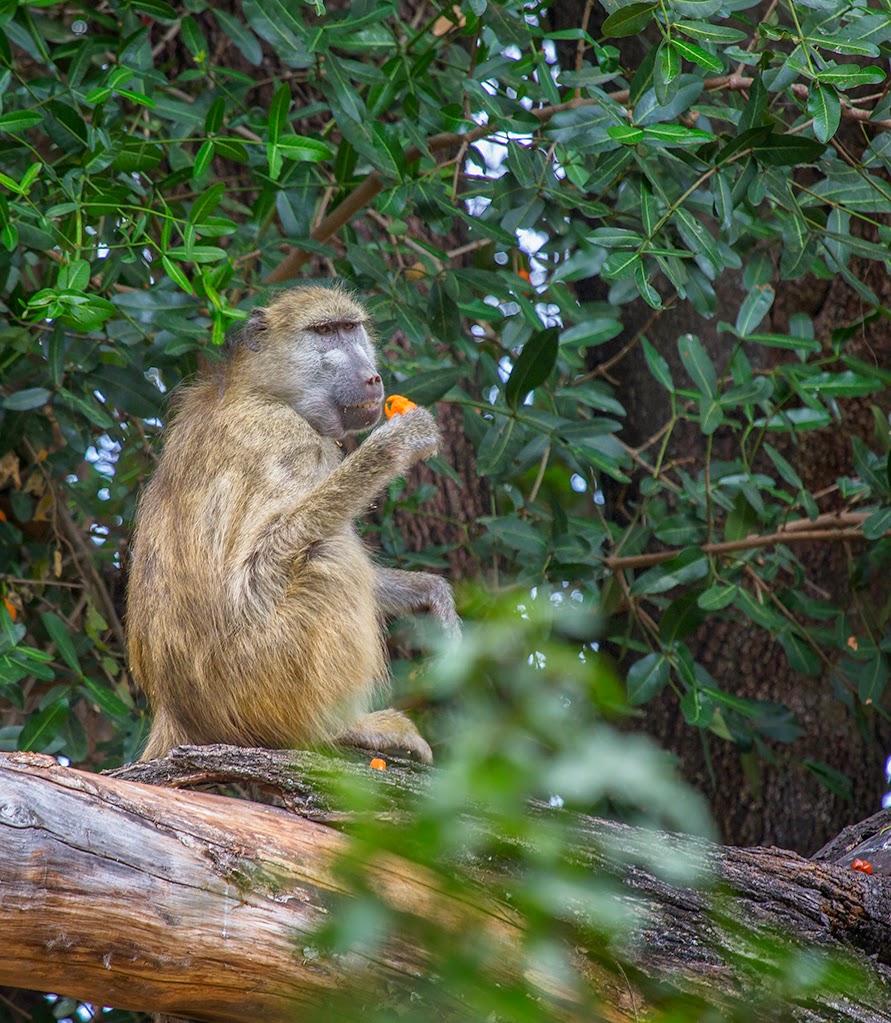
The fellow in these photos was a bit of an exception. The mangosteen trees were full of ripe fruit and he was so involved in getting his snack that he was willing to put up with me watching.
 In the end he shoved the whole fruit, peel and all, into his mouth before taking off to find another treat.

 This black-headed oriole had a nest in a tree near our cabin.


The collared sunbird, right, was feasting on the flower of the fig trees.